Confessionals for the Divine Mercy church
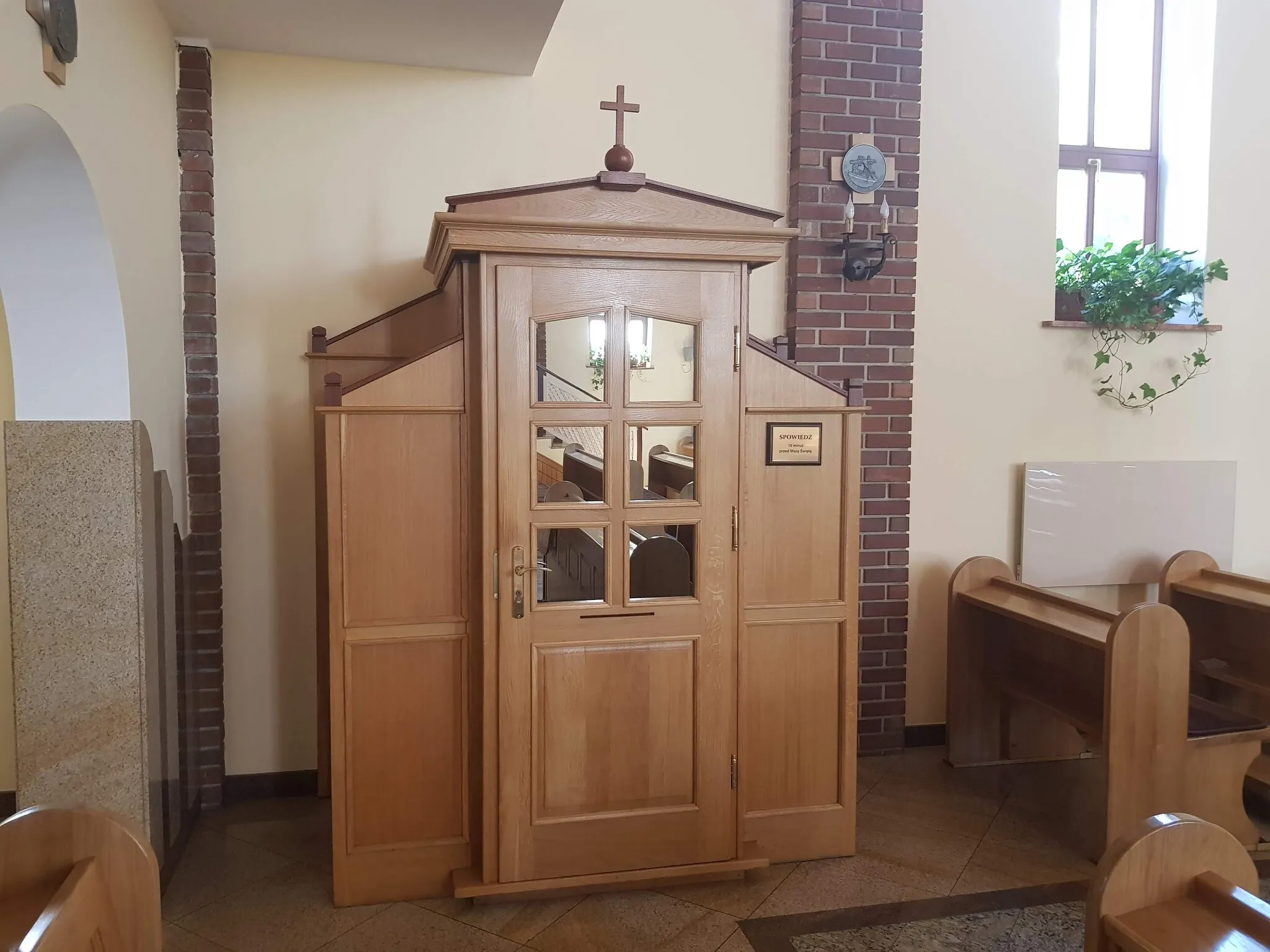
Two confessionals of the same joinery, each fitted to the place where it stands. The priest's booth is enclosed and glazed, the kneeler open.
- Location
- Zamość
- Scope
- Church workFurniture
Both confessionals are enclosed. The priest’s booth closes with a glazed door, while the penitent’s kneeler was left open and separated by an openwork grille.
A moulded cornice with a triangular pediment caps the form, and above it sits a turned ball with a cross. The door is divided into six panes in timber glazing bars, through which the priest can see whether anyone is waiting. The lower part of the door and the side walls are solid, divided into panels on the same rhythm.
The first confessional is symmetrical, with a kneeler on each side of the booth, and stands free against a brick pier. The second was fitted under the flight of stairs up to the gallery, so the form is lower and cut back on the stair side, with a kneeler on one side only. The panelling on the wall beneath the stairs belongs to the same interior, with the same plinth profile and the same panel divisions.
The grilles, the kneeler caps and the finial were stained a darker brown. The rest was left in a pale, natural tone. The kneelers and the bench inside the booth are upholstered in burgundy.
Gallery
The symmetrical confessional, with the booth in the middle and a kneeler on either side.
The door is divided into six panes, with a solid panelled section below. Above the cornice, a turned ball and a cross.
The grilles and kneeler caps were stained a darker tone. It is the only accent on the whole piece.
The side walls are divided into panels on the same rhythm as the door.
The second confessional was fitted under the stairs to the gallery, hence the lower, cut-back form.
The panelling on the wall alongside comes from the same workshop, with the plinth profile and the panel divisions repeated.
Inside the booth: a bench in burgundy upholstery, a shelf, and the grille in the dividing wall.